
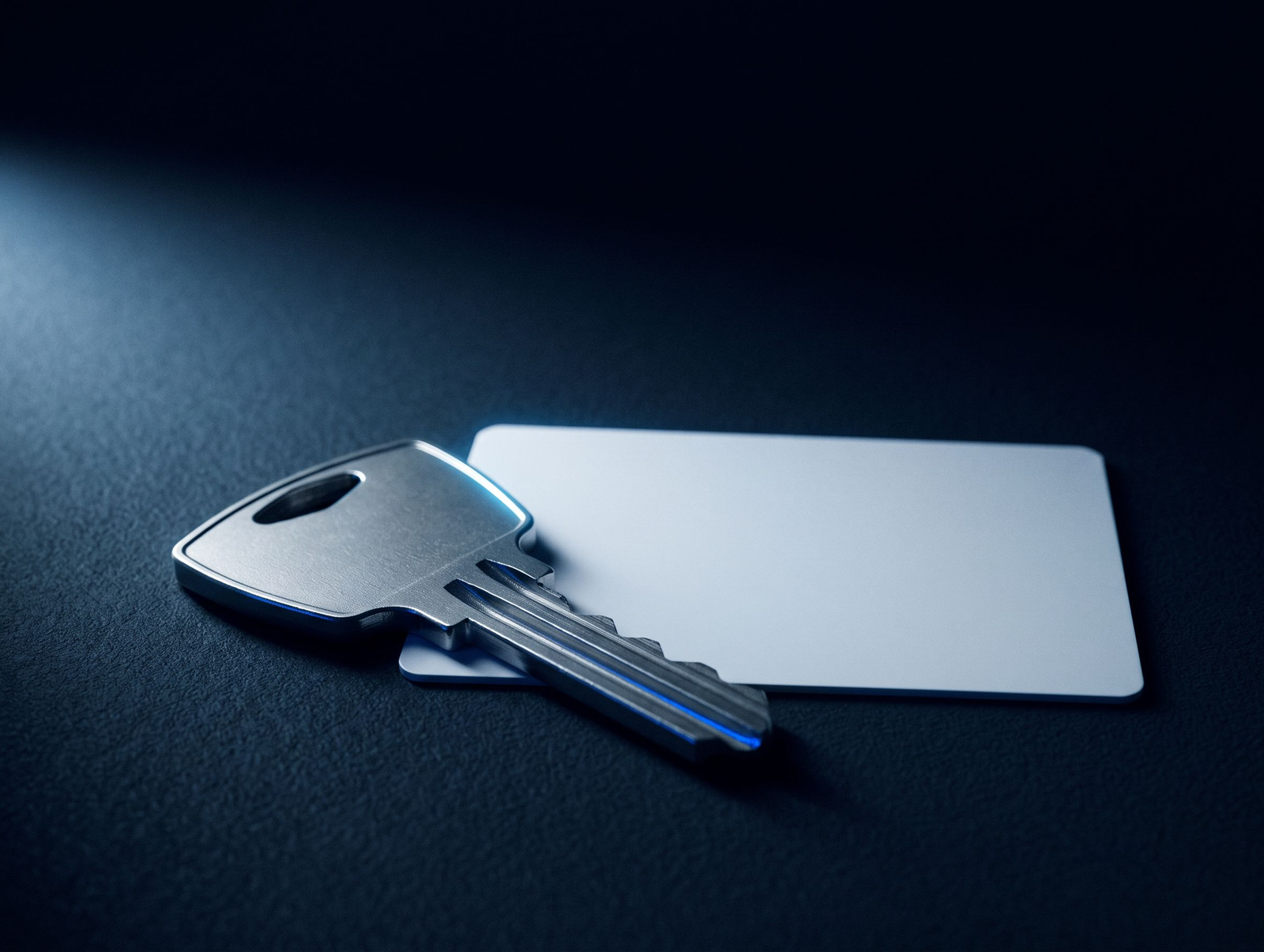
Most organisations run two access systems without ever deciding to. The electronic side, badges and readers, has a screen and an owner. The mechanical side, the keys and cylinders, lives in a spreadsheet or a drawer. Each works on its own, and neither knows what the other holds.
That is fine until someone asks a question that needs both systems at once. Who can get into the plant room? Did the contractor who left last month hand back the badge and the keys? When the answer is split between two systems that don’t share, you can’t say for sure.
Managing keys and access badges in one place is the fix. It does not mean one vendor for every lock. It means one record of who holds which keys and badges, so the question has an answer.
Key takeaways
- Two systems, one person. A contractor gets a badge from the security team and keys from the facilities desk, issued months apart, and no single record carries the pair.
- “One place” is a record, not a cabinet. You are after one page per person that lists their badges and their keys, not a bigger box on the wall.
- Four things the record has to do. Hold every badge and key against a named person, log each issue and return, keep the history for years, and tie each key to the cylinders it opens.
- See everything a person holds before you close it. When someone leaves, the record shows every badge and key they hold, so none is quietly left live.
- Match the system to the site. A mechanical-only site needs a key record tied to the locking plan. A site that spans electronic access and keys needs one record covering both.
Why keys and badges end up in two systems
As a site’s access evolves, the electronic system arrives with a building or a security upgrade and manages badges and readers, while the mechanical keys come with the locks and are tracked, if at all, in a spreadsheet kept by whoever issues them.
The two sides are run by different teams, on different screens, on different schedules. It works fine day to day. The strain shows when an audit comes, on the question that needs both at once. A person holds some badges and some keys, and no one system holds the full list.
Across several sites the gap widens. A maintenance firm holds a badge at one site and keys to the switch rooms in three others. A single record of what that firm holds, everywhere, is the only way to know what closing their access involves.

What managing keys and badges in one place actually requires
A system that covers keys and badges has to do four things separate key and badge systems cannot:
- One record per person. Every key and every badge a person holds sits against that person, so who holds what can be found in a single search.
- Issue and return tracked for keys and badges. Every badge issued and every key handed out is recorded against a responsible person and a date, including every return.
- One audit record that keeps for years. When a review happens, the answer to every question is already recorded, not reconstructed from a spreadsheet and a separate software export.
- Each key tied to the cylinders it opens. When a key does not come back, you can see exactly which doors are exposed and change only those, instead of treating a whole site as compromised.
If a system does those four, the question that crosses keys and badges has one answer. If it does not, you are back to two lists and a guess.
How to choose a system that covers keys and badges
Choose the system on how it records key movements and keeps the record, not on the hardware. Start by asking:
- Can the software show one person’s keys and badges on a single record, or are they in two places?
- Is every issue and return recorded against a named person and a date?
- Does the history stay available for years, and export cleanly for an audit or a handover?
- For mechanical keys, does the system know which cylinders each key opens?
- When someone leaves, can you list everything they hold and work through returning each key?
A key cabinet answers for the keys in that cabinet. A badge system answers for the badges. The record that covers both is the software that keeps it, not the cabinet or the reader.
Where portier fits
If you need to cover both electronic access badges and mechanical keys, portier has two products, and which one fits depends on the site. portier has built software for keys and master-key systems since 1992, and is certified to ISO/IEC 27001.
A site that needs one record across electronic access and keys suits portierX, which is invite-only ahead of launch. portierX keeps one record per person, connects electronic access systems, and tracks each key and card from issue to return. If that suits your site, ask us for a portierX invitation.
If the site uses only mechanical keys, portier Vision 5 fits: who holds which key, every issue, return and transfer against a responsible person and a date, overdue returns surfaced, and each key tied to the cylinders it opens. It works with the locking hardware already installed. See portier Vision 5 for detail and a demo request.
Common questions about managing keys and badges in one place
How can we manage keys and electronic access badges in one place?
Manage them from one record, not one piece of hardware. A single page per person lists each badge and each key they hold, logs every issue and return against a named person and a date, keeps the history for years, and ties each mechanical key to the cylinders it opens. With that record, who holds what across keys and badges is one lookup.
Can one system track both mechanical keys and access cards?
Yes, when it is built to keep one record per person covering both. The record holds each card and each key, with its issue and return, so a leaver’s full access is on one page rather than split between the security team’s badge screen and the facilities desk’s spreadsheet.
What does a record of keys and badges need to be audit-ready?
Every issue and return signed to a named person and a time, kept for years and exportable, so a review or a handover is answered from the record rather than reconstructed from memory. For the keys it also needs each one tied to the cylinders it opens.
How do you close someone’s access when they leave?
Start from the record of what they hold. Revoke the badge in the system that issued it, then reclaim the keys and confirm each one back. A key cannot be switched off from a desk, so it has to be physically returned. It is closed when the record and the departure agree, not when the badge is off and the keys are still out.
Is a spreadsheet enough to manage keys and badges together?
No. A spreadsheet shows what exists, not what happened, and it does not reach the badge side at all. It cannot prove who signed for a card or a key, hold the date and the responsible person, or link a key to the cylinders it opens. For one building it limps along. Across several it leaves you unable to show whether a leaver was actually closed out.
 English (Australia)
  Deutsch
  Français
  Nederlands